
0
Family Court

The Cost of a Family Law Consent Order in Australia

What does a consent order really cost?

One of the first questions separating couples ask is what a consent order will cost. The honest answer is that it depends on how you go about it. This guide breaks down the main components of consent order cost in Australia so you can budget with confidence and understand where your money actually goes.

The court filing fee

Every application for consent orders involves a court filing fee, payable to the Federal Circuit and Family Court of Australia when you lodge your documents. This fee is set by the court and is separate from any legal costs. Reduced fees may be available in certain circumstances, such as financial hardship or holding an eligible concession card. Because these fees are reviewed periodically, it is worth checking the current amount before you file.

Legal drafting costs

The larger variable is usually the cost of preparing the documents. Traditional family lawyers often charge by the hour, which means the final bill can be difficult to predict, especially if there is back and forth over the wording. Fixed fee services take a different approach, giving you a single agreed price for drafting your application and orders. For a straightforward agreement, this can represent a significant saving compared with open-ended hourly rates.

Why doing it cheaply can cost more

It can be tempting to save money with a DIY kit, but a poorly drafted application can be rejected by the court, leading to delays and the frustration of starting again. Orders that are unclear or do not reflect what you actually agreed can also cause disputes later, which may end up costing far more to resolve. Investing in correct drafting from the start is often the more economical choice when you weigh up the true cost of a family law consent order in Australia.

Getting clear pricing

The best way to understand your costs is to get a clear quote before you commit. The Legal Drafter offers fixed pricing for drafting consent orders, so you know exactly what you will pay with no hourly surprises. To find out the cost of formalising your agreement, request a quote and we will set out your options.

Ways to keep your costs down

There are practical steps that can keep the cost of a consent order down. The biggest is reaching a clear agreement with your former partner before any drafting begins, since unresolved disputes and repeated changes are what drive legal costs up. Being organised with your financial information also helps, as it reduces the back and forth needed to prepare your application. Choosing a fixed fee service gives you certainty about the drafting cost from the outset, rather than an open-ended hourly bill that grows as the matter drags on. Finally, getting the paperwork right the first time avoids the extra cost and delay of a rejected application. Spending a little care up front on a correctly prepared application is almost always cheaper than fixing problems later, and it gets your orders finalised sooner.


0
Family Court

How to Apply for a Consent Order in the Family Court: A Full Guide

Turning your agreement into a legal order

If you and your former partner have agreed on how to divide your property or care for your children, an application for consent orders is how you make that agreement legally binding. This guide walks through what a consent order is, how the application works, and the mistakes to avoid, so you know exactly what to expect before you begin.

What is an application for consent orders?

An application for consent orders is the process of asking the court to approve the arrangements you and your former partner have already agreed. You lodge two key documents with the Federal Circuit and Family Court of Australia: an Application for Consent Orders, which gives the court background about your circumstances, and a proposed set of orders, sometimes called a minute, setting out exactly what you want the court to approve. The court reviews these to make sure your arrangements are just and equitable for financial matters and in the best interests of any children.

The steps involved

First, reach a clear agreement covering the matters you want formalised, whether parenting, property, or both. Next, prepare the application and the proposed orders, setting out your financial position and the agreed terms in precise language. Then lodge the documents with the court, usually online, along with the filing fee. Finally, the court considers your application, generally without you needing to attend, and if it is satisfied, it makes the orders. Once sealed, they are legally binding and enforceable.

The trouble with a DIY application for consent orders kit

A DIY application for consent orders kit can look like a cheap shortcut, but it often causes problems. The orders must be worded precisely to be effective and to satisfy the court, and small errors can lead to rejection, delay, or orders that do not do what you intended. Because a rejected application can mean starting again, many people find that professional drafting saves time, money and stress in the long run.

Getting help with your consent orders

You do not have to navigate the process alone. The Legal Drafter prepares your application for consent orders and the proposed orders for you, with clear pricing and an online process you can complete from home. If you are ready to formalise your family court consent orders, request a quote and we will help you get it right the first time.

Frequently asked questions

People often ask whether they need to go to court to get consent orders. In most cases you do not, because the application is usually decided on the documents you file. Another frequent question is how long the orders take to be approved, which depends on the court’s workload once your application is lodged. Many also ask whether they still need consent orders if they already have a written agreement between themselves. The answer is usually yes, because a private agreement is not automatically enforceable in the way a court order is. Finally, people want to know what happens if their circumstances change later. Property orders are designed to be final, while parenting orders can be varied if it is in the children’s best interests. If you have a question that is not covered here, our team is happy to help you understand where you stand.

2
Family Court

Are You Representing Yourself in the Family Court or Federal Circuit Court?

With the current strain on the economy, the high cost of legal representation coupled with the lengthy delays in the Family Court and Federal Circuit Court, more and more people are representing themselves in court to resolve their property settlement and parenting arrangement.

To assist unrepresented parties or self-represented litigants in the Family Court and Federal Circuit Court, there are a range of volunteer, government and community based organisations that can assist parties with the legal process and provide legal advice.  Unfortunately, these organisations don’t have the resources to draft legal documents.

Correctly drafted legal documents, such as the orders you are seeking from the Court or Affidavit can be instrumental to the quick and desirable resolution of your matter. Too often, people without experience in legal drafting will include unnecessary or inappropriate information in their legal documents, instead of focusing on facts relevant to their matter.  Well written and accurate documents supporting your matter will give the Court the best possible view of your position.  Incorrectly drafted legal documents may place the parties at risk of a miscarriage of justice and effect the Judge’s ability to make a decision that provides a ‘just and equitable‘ property settlement and parenting orders that are in the ‘best interests‘ of the child.

Our Legal Drafter can assist you with the drafting of your legal documents.  Please contact us for a Fixed Fee.

0
Family Court Property Settlement

Family law property settlement issues in dispute?


*Here is how to identify and narrow issues in dispute…
  1. All parties are required to make frank disclosure to assist the Court in the determination of the dispute or the parties in the resolution of the dispute.
  2. Applications should only be brought before the Court if they are reasonably justified on the material available.
  3. It is expected that parties will negotiate both prior to, and at court, in order to narrow the issues in dispute before having the matter heard.
  4. When appropriate, a single expert or an assessor should be engaged to assist the parties and the Court to resolve disputes.
  5. Costs consequences may flow if parties seek to reopen issues already resolved or unreasonably agitate issues.
*The importance of Family Law Alternate Dispute Resolution…

The Courts encourage the use of appropriate dispute resolution procedures. Before commencing an action, parties are expected to make a genuine attempt to resolve their dispute, complying with the requirements and obligations of section 60I of the Family Law Act (Cth), the pre-action procedures in Schedule 1 to the Family Law Rules 2004 and rule 1.03 of the Federal Circuit Court Rules 2001 as applicable. Subject to an exception applying, the Court must not hear an application for parenting orders unless a section 60I certificate has been filed. After commencing an action, parties are expected to:

    1. be proactive in identifying the appropriate time, and the appropriate way, in which they can participate in Alternate Dispute Resolution (ADR), either by agreement or by court order; and
    2. Be prepared to consider reasonable offers of settlement at any stage of the proceedings. Failure to do so may have cost consequences.

*THE HONOURABLE JUSTICE WILLIAM ALSTERGREN CHIEF JUSTICE FAMILY COURT OF AUSTRALIA & CHIEF JUDGE FEDERAL CIRCUIT COURT OF AUSTRALIA

12
Family Court

Consent Orders Rejected by the Family Court?

Did you receive a requisition letter from the Family Court saying that your proposed Consent Orders “are unenforceable in that the Orders are not drafted in a manner capable of being made as orders of the Family Court”?

If you answered Yes, let us help you re-draft your proposed Consent Orders so they will be accepted by the Family Court.

Correctly drafted Consent Orders can be instrumental to the quick and desirable resolution of your matter. Too often, people without experience in legal drafting will include unnecessary or inappropriate information in their legal documents or omit vital information.  Well written and accurate documents supporting your matter will give the court the information required to approve your proposed Consent Orders for property settlements and parenting arrangements.

Our process is easy and straightforward!


Consent Orders

0
Parenting Arrangements

Parenting Orders – what you need to know | Family Law

  1. Proposed consent parenting orders must be drafted as precise orders that are capable of being made as orders of the Family Court.  It is all too common for parties to attempt to draft their proposed parenting orders as a statement of agreements reached between themselves.
  2. The Family Court Registry will return your proposed consent parenting orders where you have a statement of agreements.
  3. Everyone’s parenting arrangements are different, therefore your plan or orders must be tailored specifically to what is in the ‘best interests’ of your children.
  4. Your parenting orders need to be flexible enough that they consider the changing needs of your children as they develop through their younger years to their teenage years.  Orders that are suitable for today, may not be suitable in 5 or 10 years time.
  5. Be careful of DIY Kits!  They seem cheap, but remember they are computer generated and not tailored specifically to the needs of your children.
  6. The Legal Drafter specialises in drafting parenting orders.  We can assist you to draft orders specifically to your family’s situation so that it complies with the Family Law Act 1975 (Cth).


4
legally binding consent orders

Are Consent Orders Legally Binding?

Yes, Consent Orders are legally binding when they have been approved by the Family Court of Australia/Family Court of Western Australia.  Consent Orders have the same legal effect as an order made after a court hearing.

When you reach an agreement about property and financial matters, including superannuation and/or parenting arrangements, and you want to formalise that agreement to make it binding, you can apply to the Family Court for Consent Orders.  Once the Consent Orders are approved by the Family Court, the orders are binding and legally enforceable on both you and your former spouse.

Consent Orders can include orders about:

  • property and finances
  • superannuation
  • spousal maintenance
  • parenting

Consent Orders can’t include orders about child support or wills and estates.

There are time restrictions as to when you can file your Consent Orders.  An Application (Consent Orders) for a property and financial settlement must be filed within 12 months from the date of a divorce order taking effect.  For a de facto relationship, an Application must be filed within 2 years from the date of separation.

If you are out of time, you can still seek leave from the Family Court by including an order that you consent to making the orders out of time.

You are not required to attend Court as the Application is reviewed administratively by a Registrar of the Family Court.  You are not required to seek independent legal advice – this is optional.

At The Legal Drafter we make your Application for Consent Orders an easy and straightforward process.  Our fixed fee service provides you with the price in advance so you can decide for yourself if you can afford the cost before you make the decision to use our services.

Unfortunately, most law firms are unable to provide fixed fees because they rely on billable hours.  This means you won’t know how much your Application for Consent Orders will cost you, and this could range between $5,000 and $15,000.

If you require further information about Consent Orders please visit our website here, or alternatively the Family Court of Australia or Family Court of Western Australia.

0

DIY Kits for Consent Orders – Will they be approved by the Family Court?

It is unlikely they will be approved by the Family Court where you have completed an online DIY kit.  DIY kits do not provide 100s of different templates that will fit perfectly to the needs of your property settlement or parenting arrangements. Each property settlement and parenting arrangement is different and must be drafted specifically to your situation in accordance with the Family Law Act 1975.

Correctly drafted court documents can be instrumental to the quick and desirable resolution of your matter.  Too often, people without experience in legal drafting will include unnecessary or inappropriate information in their court documents instead of focusing on facts relevant to their matter.

Well written and accurate documents supporting your matter will give the court the best possible view of your position.  It will prevent your Consent Orders being returned to you because they are incorrectly drafted.

We are experienced at drafting Consent Orders – it is what we do every day!

0
consent orders

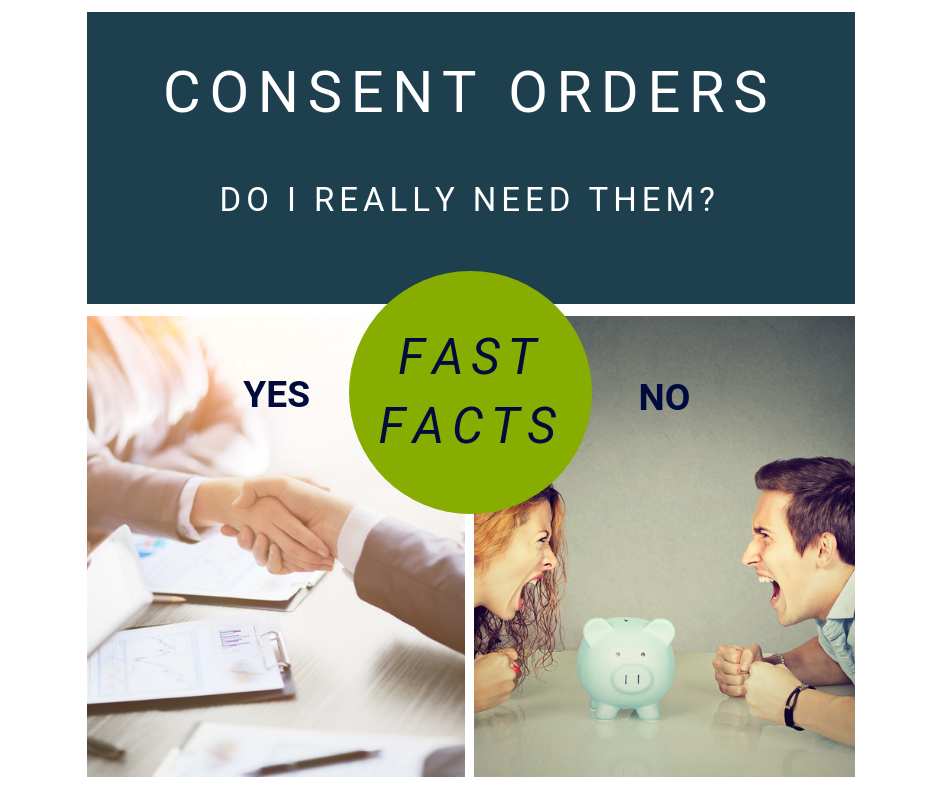
Consent Orders – Do I Really Need Them?

YES

1. The agreement is approved by the Family Court;

2. It has the same effect as a court order made by a judicial officer;

3. The terms must be followed as stated in the document;

4. It finalises the financial matters between you and your former spouse;

5. There are stamp duty exemptions (in some cases) for a transfer of property from one spouse to another; and

6. If you are splitting your superannuation, you must have an order of the court (consent orders).

NO

1. If you have already divided your finances and transferred or sold your property; and

2. There are no assets, liabilities or superannuation to divide.

(This list is not exhaustive and is not intended as legal advice.)

0

Secretly Recording Your Spouse’s Conversations

recording spouse's conversation cartoon

Secretly recording your spouse’s conversation where there is family violence is an issue that has been discussed widely.  When family violence, child abuse and neglect takes place behind closed doors without any witnesses being present, it is very difficult to provide evidence to the family courts when it is illegal to secretly record conversations in some instances.  However, with increasing public awareness and media attention, the difficulties of obtaining evidence behind closed doors is now being recognised by the family courts.

In the New South Wales case of Janssen & Janssen the court noted on the facts before them that, “it is notoriously difficult to obtain evidence of family violence which takes place behind closed doors”.  The court stated that the decision to admit the secret recordings in this case were based on the particular facts of the case and that the father had maintained a charming public face but had engaged in conduct that alleged to have constituted family violence under the Family Law Act 1975 (Cth).

The Independent Children’s Lawyer (ICL) in this case submitted that in secretly recording your spouse’s conversations would also assist in determining the parenting abilities of the primary carer which may have been compromised as a result of the content and tone of the communication of the father.  It is not only what was said in the recordings, but also how it was said.

The Family Court said that evidence from secretly recording your spouse’s conversation in relation to family violence matters will have to be:

  1. established clearly;
  2. matters of opinion put in appropriate context and given appropriate weight;
  3. dependant upon who was expressing the opinion and on what basis; and
  4. the establishment of the necessary background facts.

Please note that the law in Queensland in relation to privacy and the recording of conversations is different from the law in New South Wales and other states:

  • it is illegal to record a telephone call with a device physically attached to the telephone;
  • it is illegal for a person who is not a party to the conversation to record a conversation, whether by telephone or face to face.
  • it is legal for a telephone call to be secretly recorded by an external device by a person who is a party to the conversation; and
  • it is legal for a person who is not a party to the conversation to record a conversation, whether by telephone or face to face.
1 2
Call Now Button