
0
Family Court

Consent Order Cost: The Cost of a Family Law Consent Order in Australia (2026)

Making your property and parenting agreements legally binding should not drain your bank account. You have already done the hard work of reaching an agreement with your former partner. Now you need to know what it costs to make it official. This guide breaks down the costs of finalising your separation in 2026.

How Much Does a Consent Order Cost in Australia?

The total cost of a consent order is made up of two parts: the mandatory court filing fee, and the professional drafting fee if you engage someone to prepare the legal paperwork.

If you complete everything yourself using the court’s DIY kit, you pay only the court fee. If you engage a traditional law firm on hourly rates, the total can run to several thousand dollars. The final price depends entirely on the path you choose.

Option What You Pay Key Risk or Benefit
DIY court kit Court filing fee only Higher risk of errors and requisitions
Fixed fee drafting service One agreed fee plus filing fee Cost certainty, professionally drafted documents
Traditional firm (hourly) Hourly rates plus filing fee Final cost unknown until the end

Court Filing Fee for Consent Orders

The Federal Circuit and Family Court of Australia charges a standard lodgement fee for every Application for Consent Orders, currently $215, with fees reviewed at the start of each financial year. Current fees are published by the FCFCOA.

You pay this fee directly to the court when you upload your signed documents to the Commonwealth Courts Portal. It is a one-off payment, and the court does not charge extra if your application covers both property and parenting matters.

Lawyer Fees: Fixed Fee vs Hourly Rates

Under hourly billing, every phone call, email and revision adds to the final bill, and the final invoice can exceed the initial estimate.

Fixed fee services take a different approach: you know exactly what you will pay before drafting begins. This removes financial uncertainty from an already stressful situation. You are paying for the outcome, not the time it takes to get there.

What Affects the Cost of a Consent Order (Property, Parenting, Super Splitting)

Complex agreements require more detailed drafting. A simple property transfer is relatively straightforward, while superannuation splits require specific legal wording and approval from the super fund trustee before filing.

Parenting arrangements need careful drafting of schedules, changeovers and parental responsibilities. Some firms increase fees based on the complexity of the asset pool or the number of children involved, so it pays to confirm the scope of any fixed fee upfront.

Fee Waivers and Reductions: Who Qualifies

You may not have to pay the full court filing fee. The family court offers reduced fees for people experiencing financial hardship. You can apply for a reduction if you hold certain government concession cards, or if you receive legal aid, Youth Allowance, Austudy or Abstudy. A specific exemption form must be submitted with your application to secure the reduced rate.

Hidden Costs to Watch For (Requisitions, Redrafting, Conveyancing)

Doing it yourself can cost more in the long run. If the court finds errors in a DIY application, it issues a requisition, meaning the application is sent back for correction. Fixing these errors often means paying for legal help at short notice.

Transferring real estate also requires a conveyancer, whose fees are separate from the family court costs. Budget for property transfer costs once your orders are approved. For complex asset pools, our financial matters service can help you plan the full picture.

How a Consent Order Saves You Money (Stamp Duty and Avoiding Litigation)

A consent order is an investment that typically pays for itself many times over. Contested court proceedings over a property split can cost tens of thousands of dollars in legal fees; a consent order avoids litigation entirely.

Just as importantly, transfers made under sealed consent orders are generally exempt from state stamp duty. When the family home moves into one person’s name under a property settlement consent order, this exemption alone can save separating couples a very substantial amount.

The Legal Drafter’s Fixed Fee Consent Order Pricing

We believe in complete transparency. The Legal Drafter provides a family law drafting service with no hidden costs, focusing on consent orders for property settlements, superannuation splits, spousal maintenance and parenting arrangements.

Our fixed fees mean no surprise bills. We offer a 24-hour drafting turnaround and guide you through the process until your orders are approved by the court. To get an exact price for your matter, contact The Legal Drafter for a fixed fee quote, available anywhere in Australia.

Frequently Asked Questions

What is the court filing fee for consent orders in 2026?

The court filing fee for an Application for Consent Orders is $215 as of 2026. It is a one-off payment made to the Federal Circuit and Family Court of Australia when filing, and it covers both property and parenting matters in a single application.

Can I get the consent order filing fee reduced?

Yes, the filing fee can be reduced for eligible applicants. Holders of certain government concession cards, and people receiving legal aid, Youth Allowance, Austudy or Abstudy, can apply for a reduced fee by submitting the relevant exemption form with their consent order application.

Is a consent order cheaper than going to court?

Yes, a consent order is significantly cheaper than contested court proceedings. Litigation over property can cost tens of thousands of dollars, while a consent order involves only a fixed drafting fee and the court filing fee, plus potential stamp duty savings on property transfers.

Does a consent order avoid stamp duty?

Generally yes, property transfers between separating parties under sealed consent orders are exempt from state stamp duty. This exemption can save a substantial amount when transferring the family home, and it is one of the main financial reasons couples formalise their agreement through consent orders.

This article contains general information only and does not constitute legal advice.

0
Family Court

Application for Consent Orders: How to Apply for a Consent Order in Australia (Step-by-Step Guide)

Sorting out your property, finances and parenting arrangements after a separation is stressful enough. You and your former partner have finally agreed on the terms. Now you want it written up legally so you can both move on. This guide explains exactly how to finalise your agreement through the family law system.

What Is an Application for Consent Orders?

An Application for Consent Orders is a formal document submitted to the Federal Circuit and Family Court of Australia asking the court to make your private agreement legally binding. Once approved, the orders have the same legal force as orders made by a judge after contested proceedings.

Consent orders can cover property settlements, superannuation splits, spousal maintenance and parenting arrangements. Formalising the agreement promptly protects both parties if one later changes their mind.

The Application for Consent Orders Kit Explained (FCFCOA Do-It-Yourself Kit)

The court provides a DIY kit for people who want to handle the paperwork themselves. It includes a lengthy application form but doesn’t include the draft order template.

You need to complete detailed financial information, relationship history and proposed parenting schedules. The kit is comprehensive, but it is also notoriously confusing for people without a legal background, and one small drafting mistake can cause major delays.

How to Apply for Consent Orders in the Family Court: Step by Step

The process requires strict attention to detail. Follow these steps to get your orders approved:

  1. Reach a complete agreement with your former partner on all financial and parenting matters.
  2. Draft the proposed consent orders using the exact legal formatting the court requires.
  3. Complete the Application for Consent Orders form.
  4. Both parties sign the documents and in WA they sign in front of an authorised witness such as a Justice of the Peace. 
  5. Create an account on the Commonwealth Courts Portal.
  6. Upload all signed documents and pay the court filing fee.
  7. Wait for a judicial officer to review your application in chambers.

Documents You Need Before You Apply

Preparation is everything. Gathering the right paperwork early avoids delays later. You will need:

  • For superannuation splits, a letter from the super fund trustee confirming no objection to the proposed split.
  • The completed Application form and the drafted consent orders themselves.
  • In WA you require a copy of your marriage certificate or evidence of your de facto relationship and recent title searches searches for any real estate involved in a property settlement.

Filing Your Application on the Commonwealth Courts Portal

There is no need to line up at a family court registry: filing now happens online. You register for the Commonwealth Courts Portal, select the option to file a new application, upload your signed documents as PDF files and pay the filing fee by card. The portal is also where you track the progress of your application.

Common Reasons Applications for Consent Orders Get Rejected or Requisitioned

The court does not simply rubber-stamp agreements. A Registrar reviews every application to ensure it is just and equitable. Common problems include:

  • Vague or ambiguous drafting, which leads to the application being requisitioned (sent back for correction).
  • Parenting orders that are not practical to enforce.
  • Mathematical errors in the property pool calculations.
  • Superannuation funds not being properly notified before filing, which stops the application entirely.

DIY Kit vs Lawyer-Drafted Application: Which Is Safer?

Factor DIY Kit Lawyer-Drafted Application
Upfront cost Court filing fee only Fixed drafting fee plus filing fee
Risk of requisition Higher, due to drafting errors Low, drafted to court requirements
Time to approval Often delayed by corrections Typically faster, right the first time
Support None Guidance through to approval

The DIY kit saves money upfront, but if you make a mistake the court sends it back, dragging out an already emotional process. A lawyer-drafted application removes the guesswork. The Legal Drafter focuses on consent orders, offering fixed fees, a 24-hour drafting turnaround and guidance through the process until your orders are approved.

How Long Does the Court Take to Approve Consent Orders?

Timeframes vary with registry workload. Generally, you can expect an outcome within four to six weeks of filing, though complex matters can take up to twelve. Nobody has to attend court: a Registrar reviews the paperwork in chambers and, if everything is drafted correctly, seals the orders and uploads them to your portal account.

Ready to Finalise Your Agreement?

Formalising your agreement now gives both parties certainty and stops either side reopening the negotiation later. Whether your orders cover property, superannuation or parenting arrangements, we handle the drafting so you can move forward. Contact The Legal Drafter for fast, fixed fee consent orders anywhere in Australia.

Frequently Asked Questions

Can I apply for consent orders without a lawyer?

Yes, you can apply for consent orders without a lawyer using the court’s DIY kit. However, drafting errors are the most common reason applications are requisitioned or rejected. Many couples use a fixed fee drafting service to have the documents prepared correctly the first time.

Do both parties have to agree to consent orders?

Yes, both parties must fully agree before consent orders can be filed.In WA, both must sign the Application and the proposed orders. If either party disagrees or later withdraws consent before approval, the application cannot proceed as a consent order.

What happens after consent orders are approved?

After approval, the sealed consent orders are uploaded to your Commonwealth Courts Portal account and become legally binding on both parties. You can then act on the orders, such as transferring property, splitting superannuation or implementing parenting arrangements. A breach can be enforced through the court.

This article contains general information only and does not constitute legal advice.

2
Family Court

Are You Representing Yourself in the Family Court or Federal Circuit Court?

With the current strain on the economy, the high cost of legal representation coupled with the lengthy delays in the Family Court and Federal Circuit Court, more and more people are representing themselves in court to resolve their property settlement and parenting arrangement.

To assist unrepresented parties or self-represented litigants in the Family Court and Federal Circuit Court, there are a range of volunteer, government and community based organisations that can assist parties with the legal process and provide legal advice.  Unfortunately, these organisations don’t have the resources to draft legal documents.

Correctly drafted legal documents, such as the orders you are seeking from the Court or Affidavit can be instrumental to the quick and desirable resolution of your matter. Too often, people without experience in legal drafting will include unnecessary or inappropriate information in their legal documents, instead of focusing on facts relevant to their matter.  Well written and accurate documents supporting your matter will give the Court the best possible view of your position.  Incorrectly drafted legal documents may place the parties at risk of a miscarriage of justice and effect the Judge’s ability to make a decision that provides a ‘just and equitable‘ property settlement and parenting orders that are in the ‘best interests‘ of the child.

Our Legal Drafter can assist you with the drafting of your legal documents.  Please contact us for a Fixed Fee.

0
Family Court Property Settlement

Family law property settlement issues in dispute?


*Here is how to identify and narrow issues in dispute…
  1. All parties are required to make frank disclosure to assist the Court in the determination of the dispute or the parties in the resolution of the dispute.
  2. Applications should only be brought before the Court if they are reasonably justified on the material available.
  3. It is expected that parties will negotiate both prior to, and at court, in order to narrow the issues in dispute before having the matter heard.
  4. When appropriate, a single expert or an assessor should be engaged to assist the parties and the Court to resolve disputes.
  5. Costs consequences may flow if parties seek to reopen issues already resolved or unreasonably agitate issues.
*The importance of Family Law Alternate Dispute Resolution…

The Courts encourage the use of appropriate dispute resolution procedures. Before commencing an action, parties are expected to make a genuine attempt to resolve their dispute, complying with the requirements and obligations of section 60I of the Family Law Act (Cth), the pre-action procedures in Schedule 1 to the Family Law Rules 2004 and rule 1.03 of the Federal Circuit Court Rules 2001 as applicable. Subject to an exception applying, the Court must not hear an application for parenting orders unless a section 60I certificate has been filed. After commencing an action, parties are expected to:

    1. be proactive in identifying the appropriate time, and the appropriate way, in which they can participate in Alternate Dispute Resolution (ADR), either by agreement or by court order; and
    2. Be prepared to consider reasonable offers of settlement at any stage of the proceedings. Failure to do so may have cost consequences.

*THE HONOURABLE JUSTICE WILLIAM ALSTERGREN CHIEF JUSTICE FAMILY COURT OF AUSTRALIA & CHIEF JUDGE FEDERAL CIRCUIT COURT OF AUSTRALIA

12
Family Court

Consent Orders Rejected by the Family Court?

Did you receive a requisition letter from the Family Court saying that your proposed Consent Orders “are unenforceable in that the Orders are not drafted in a manner capable of being made as orders of the Family Court”?

If you answered Yes, let us help you re-draft your proposed Consent Orders so they will be accepted by the Family Court.

Correctly drafted Consent Orders can be instrumental to the quick and desirable resolution of your matter. Too often, people without experience in legal drafting will include unnecessary or inappropriate information in their legal documents or omit vital information.  Well written and accurate documents supporting your matter will give the court the information required to approve your proposed Consent Orders for property settlements and parenting arrangements.

Our process is easy and straightforward!


Consent Orders

0

Financial Agreements – What you need to know…

What You Need To Know Before Signing a Binding Financial Agreement

Where there is duress, undue influence or unconscionable conduct at the time of entering into a Binding Financial Agreement, the court will set aside the agreement.

In the recent case of Thorne v Kennedy, the High Court of Australia set aside two (2) financial agreements on the grounds of duress, undue influence and unconscionable conduct.

The Facts

The Husband (Mr Kennedy) – 67 years old divorcee with three adult children and assets worth between $18-24 million.

The Wife (Ms Thorne) – moved to Australia in 2007 after meeting Mr Kennedy online 7 months prior.  Ms Thorne, a 36 year old European woman had limited English and no substantial assets.

On 20 September 2007, 10 days prior to the wedding, the parties entered into an agreement despite Ms Thorne receiving independent legal advice advising her not to sign the agreement.  However, Mr Kennedy informed Ms Thorne that if she did not sign the agreement the wedding would not proceed.  At this time, Ms Thorne’s sister and parents had travelled to Australia for the wedding and were staying with the parties in Mr Kennedy’s home.

Only 4 days before the wedding, the Wife signed the first agreement.  On 5 November 2007, 30 days after the wedding, the wife signed a substantially identical post-nuptial agreement (the second agreement).  Again, the Wife received independent legal advice not to sign the agreement.  The agreement was for the Wife to claim $50,000 after three or more years of marriage and if the Husband died while the parties were living together the Wife would receive a penthouse worth up to $1.5M, a Mercedes and a continuing income.

In 2011, the parties divorced, and the Wife commenced proceedings in the Federal Circuit Court seeking a property settlement claim of $1.24M, including spousal maintenance.  In 2014, during the court proceedings, the Husband died, and the Husband’s estate continued to prevent the Wife from making a claim on the estate.

The Decision

In March 2015, the Federal Circuit Court (the primary judge’s decision) set aside both agreements and held that the Wife had “signed the Agreements under duress borne of inequality of bargaining power where there was no outcome to her that was fair and reasonable”.  The court relied upon 6 factors in determining their decision:

  1. the Wife’s lack of financial equality with the Husband;
  2. the Wife’s lack of permanent status in Australia at the time;
  3. the Wife’s reliance on Mr Kennedy for all things;
  4. the Wife’s emotional connectedness to their relationship and prospect of motherhood;
  5. the Wife’s emotional preparation for marriage; and
  6. the publicness of her upcoming marriage.

The Husband’s executors appealed to the Full Court of the Family Court which overturned the Federal Circuit Court decision.  The Full Court found the agreements to be fair and reasonable because the Wife had been told by the Husband at the outset of their relationship, and she accepted it, that his wealth was for his children and provisions were made for the Wife should the Husband predecease her.  The Full Court also held that the Husband’s conduct was not unconscionable because:

  1. there was no misrepresentation made by the Husband about his financial position;
  2. the Husband made it clear at the outset that the Wife would not receive any part of his wealth on separation;
  3. the Wife believed the Husband would never leave her and her lack of concern about her financial position; and
  4. the Husband’s acceptance of handwritten amendments to the agreements that were made by the Wife’s solicitor.

The Wife then appealed the Full Court’s decision and the appeal was heard in the High Court of Australia in August 2017 and the Judgement was delivered in November 2017.

The High Court upheld the Federal Circuit Court’s decision and found the agreements had been entered into by duress, undue influence and unconscionable conduct.

The matter was returned to the Federal Circuit Court awaiting judicial determination regarding the Wife’s application for a property settlement and spousal maintenance.

This Case Provides Some Clarity For The Future

The High Court in Thorne & Kennedy listed 6 factors which will be more strongly considered where there has been duress, undue influence and unconscionable conduct in the context of pre-nuptial and post-nuptial agreements (at [60]):

  1. whether the agreement was offered on a basis that it was not subject to negotiation;
  2. the emotional circumstances in which the agreement was entered including any explicit or implicit threat to end a marriage or to end an engagement;
  3. whether there was any time for careful reflection;
  4. the nature of the parties’ relationship;
  5. the relative financial positions of the parties; and
  6. the independent advice that was received and whether there was time to reflect on that advice.

Please note that the High Court gave clarity to further issues, and some still remain unresolved.

This article is not legal advice and is intended to provide general information only. 

4
legally binding consent orders

Are Consent Orders Legally Binding?

Yes, Consent Orders are legally binding when they have been approved by the Family Court of Australia/Family Court of Western Australia.  Consent Orders have the same legal effect as an order made after a court hearing.

When you reach an agreement about property and financial matters, including superannuation and/or parenting arrangements, and you want to formalise that agreement to make it binding, you can apply to the Family Court for Consent Orders.  Once the Consent Orders are approved by the Family Court, the orders are binding and legally enforceable on both you and your former spouse.

Consent Orders can include orders about:

  • property and finances
  • superannuation
  • spousal maintenance
  • parenting

Consent Orders can’t include orders about child support or wills and estates.

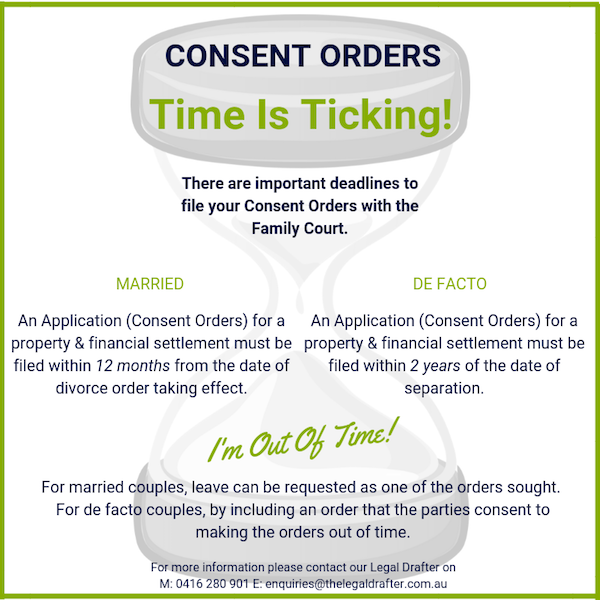
There are time restrictions as to when you can file your Consent Orders.  An Application (Consent Orders) for a property and financial settlement must be filed within 12 months from the date of a divorce order taking effect.  For a de facto relationship, an Application must be filed within 2 years from the date of separation.

If you are out of time, you can still seek leave from the Family Court by including an order that you consent to making the orders out of time.

You are not required to attend Court as the Application is reviewed administratively by a Registrar of the Family Court.  You are not required to seek independent legal advice – this is optional.

At The Legal Drafter we make your Application for Consent Orders an easy and straightforward process.  Our fixed fee service provides you with the price in advance so you can decide for yourself if you can afford the cost before you make the decision to use our services.

Unfortunately, most law firms are unable to provide fixed fees because they rely on billable hours.  This means you won’t know how much your Application for Consent Orders will cost you, and this could range between $5,000 and $15,000.

If you require further information about Consent Orders please visit our website here, or alternatively the Family Court of Australia or Family Court of Western Australia.

0

DIY Kits for Consent Orders – Will they be approved by the Family Court?

It is unlikely they will be approved by the Family Court where you have completed an online DIY kit.  DIY kits do not provide 100s of different templates that will fit perfectly to the needs of your property settlement or parenting arrangements. Each property settlement and parenting arrangement is different and must be drafted specifically to your situation in accordance with the Family Law Act 1975.

Correctly drafted court documents can be instrumental to the quick and desirable resolution of your matter.  Too often, people without experience in legal drafting will include unnecessary or inappropriate information in their court documents instead of focusing on facts relevant to their matter.

Well written and accurate documents supporting your matter will give the court the best possible view of your position.  It will prevent your Consent Orders being returned to you because they are incorrectly drafted.

We are experienced at drafting Consent Orders – it is what we do every day!

0
consent orders

Consent Orders – Do I Really Need Them?

YES

1. The agreement is approved by the Family Court;

2. It has the same effect as a court order made by a judicial officer;

3. The terms must be followed as stated in the document;

4. It finalises the financial matters between you and your former spouse;

5. There are stamp duty exemptions (in some cases) for a transfer of property from one spouse to another; and

6. If you are splitting your superannuation, you must have an order of the court (consent orders).

NO

1. If you have already divided your finances and transferred or sold your property; and

2. There are no assets, liabilities or superannuation to divide.

(This list is not exhaustive and is not intended as legal advice.)

1 2
Call Now Button