The Federal Circuit Court of Australia in Brisbane is now part of the Federal Circuit and Family Court of Australia, which started on 1 September 2021. Property and financial applications from Brisbane are heard in that court. This guide explains how a property case runs today, and how you can avoid it by agreeing.
Key Takeaways
- One court: the Federal Circuit Court and the Family Court of Australia combined into one court with two divisions.
- 2019 change is history: the Brisbane registrar listing process described in our original post has been replaced by national case management.
- Agreeing is faster: consent orders let you finalise a property settlement without attending court.
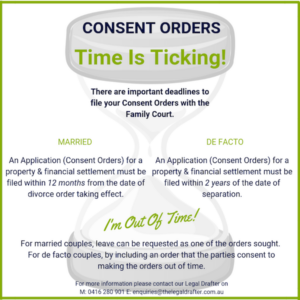
- Time limits: 12 months from a divorce order, or 2 years from the end of a de facto relationship.
What Changed Since 2019
From 30 September 2019, parties seeking property and financial orders in the Federal Circuit Court Brisbane registry were listed before a Registrar on the first court date. A Registrar managed the case until the dispute resolution process ended. Before that, parties were listed before a Judge. Referral to a Judge was only permitted in cases of genuine urgency.
That court no longer exists on its own. The table shows what has changed.
| Feature | 2019 Brisbane Registry | Today |
|---|---|---|
| Court | Federal Circuit Court of Australia | Federal Circuit and Family Court of Australia, Division 2 or Division 1 |
| Case management | Registrar listing set by the Brisbane registry | A national Central Practice Direction for family law case management |
| Disclosure rule | Earlier family law rules | Rule 6.06 of the Family Law Rules 2021 |
The Court Today: Division 1, Division 2 and the Brisbane Registry
The court has two divisions. All matters are filed in Division 2, but may then be allocated to Division 1. Division 2 hears most matters at first instance, and Division 1 hears some more complex matters and appeals.
- Filing: you file in Division 2, and the court decides whether your case stays there.
- Brisbane registry: the court has a Brisbane registry, and its page lists the location and contact details.
- Central Practice Direction: it sets pre-action requirements, filing, urgency, triage and the court events.
The court's Brisbane registry page has the current address and contact details.
First Court Event: Who Hears Your Case
For a smaller property case, the court uses a faster pathway called a PPP Case. The court describes it as a case where a party seeks only financial orders, the net value of the property of the parties (excluding superannuation) is, or is likely to be, less than $550,000, and other criteria are met.
- Who hears it: on the first court date, a PPP Case is listed before a Judicial Registrar.
- Who they are: an officer of the court with specialised qualifications and experience in family law, court procedure and dispute resolution.
- Limits: a Judicial Registrar cannot determine your case on a final basis, and refers it to a judge if it does not resolve by agreement.
- Preparation: if you agree on most items, you can bring a balance sheet to the first court event.
Unless the court tells you otherwise, your first court event may take place on Microsoft Teams. The court sends a link in the days before.
Steps Before and After You File
The Family Law Rules require prospective parties to genuinely try to resolve their dispute before starting a case. The court's pre-action brochure sets out these steps:
- Give the other party a copy of the pre-action procedures and invite them to dispute resolution.
- Agree on a dispute resolution service and make a genuine effort to resolve the dispute.
- If that fails, send a written notice of intention with the issues in dispute, the orders you will seek, a genuine offer and a reply time of at least 14 days.
- Reply in writing if you receive a notice, with a counter offer if you do not accept.
- If you cannot agree, file an application with a Genuine Steps Certificate.
Our guide to property settlement issues in dispute shows how to narrow what the court needs to decide.
Disclosure Applies Before and During Court
Each party must give full and frank disclosure of their financial circumstances. The duty includes all of your financial circumstances after separation and continues up until the date of hearing. It is described in rule 6.06 of the Family Law Rules 2021.
- Check the other side: the court says each party should check that what the other party has disclosed is accurate.
- Typical documents: tax returns, pay slips, bank statements and superannuation statements.
Our guide to full and frank disclosure lists the documents to gather before your first court event.
Agree Instead: Consent Orders From Brisbane
If you and your former partner agree on how to divide your property, you can ask the court to make consent orders without a hearing. The table compares the two paths.
| Feature | Court Case | Consent Orders |
|---|---|---|
| Attending court | A first court event, sometimes on Teams | Not required |
| Who decides | The court, if you cannot agree | You and your former partner agree, the court approves |
| Time limit | 12 months from divorce, or 2 years from a de facto relationship ending | The same time limits apply |
| Fixed fee | Not available | $1,980 with The Legal Drafter, plus the $215 filing fee |
We prepare property settlement consent orders for clients Australia wide, including consent orders in Queensland.
Frequently Asked Questions
Is there a family law court in Brisbane?
Yes. The Federal Circuit and Family Court of Australia has a registry in Brisbane. Family law matters from Brisbane are filed in Division 2 of that court, and the court decides whether a case stays there or moves to Division 1. You can check the court's Brisbane registry page for the address and contact details.
What happened to the Federal Circuit Court in Brisbane?
The Federal Circuit Court of Australia and the Family Court of Australia merged to form the Federal Circuit and Family Court of Australia, which began on 1 September 2021. The old registrar listing process we described in 2019 has been replaced by the court's national case management system and Central Practice Direction.
Do I have to go to court to settle my property in Brisbane?
Not if you agree. You can apply for consent orders, and the court can make them without a hearing. If you cannot agree, you must first follow the pre-action steps, and then your case is listed for a first court event. Many people agree once they have narrowed the issues.
How long do I have to apply for a property settlement?
You should file within 12 months of a divorce order taking effect, or within 2 years of the end of a de facto relationship. If you are outside those limits, you need the court's leave. Our guide to the property settlement time limit explains how that works.
Ready to Finalise Your Property Settlement?
If you have agreed on the property, we can draft your consent orders. Rated 5.0 on Google, Facebook and Trustpilot, The Legal Drafter works with clients Australia wide. Our Rapid Consent Orders Package includes:
- Fixed fee: $1,980, with no hourly billing.
- Turnaround: consent orders ready to sign in 24 hours (T&Cs apply).
- Free call: book your free 15-minute Rapid Settlement Call, call 0416 280 901 or email enquiries@thelegaldrafter.com.au.
This article contains general information only and does not constitute legal advice.